Saturday, July 19, 2014

2 weeks in Scotland

A340-600
2 weeks in Scotland to enjoy the cool summer and to spend my birthday with family and friends. I paid for extra baggage allowance so that I could take back 50kg of things back to Scotland. The flight was on time, but Virgin Atlantic is one short step away from being a Low Cost Carrier (LCC).
Flight paths

When I arrived at Heathrow, I had a beer and was drawn to the TV news which said a Malaysian Airlines plane had been shot down in the east of Ukraine - I'm guessing my flight was only about 400 miles away from the Malaysian plane when it went down.

So far, I have managed to deal with the worst of my jet lag, had a couple of nice meals with my parents, and managed to enjoy a couple of good ales. The next few days will be busy meeting old friends for hiking, further drinks, and birthday celebrations. A short visit to Skye is also planned.

More Scotland updates to follow soon.

Thursday, July 17, 2014

Final thoughts on North Korea


An accurate summary
A lot of my thoughts about North Korea are conveniently contained within a Huffington Post article titled '20 Things I Learned While I Was in North Korea'. I'd recommend taking the time to read it. Not all of the 20 points I agree with or experienced, but here are the ones that are most relevant to my visit to North Korea:
The leaders are a really big fucking [sic] deal there
Everywhere you go, you are reminded about the wonderful and godlike Kim dynasty. Impressive statues are everywhere, depicting the leaders in a range of heroic poses. It seemed like most people we met wore a lapel badge showing either the first leader or the two deceased leaders together. When we took photos of statues, we had to abide by strict rules of propriety or risk having our memory cards deleted. If we touched a newspaper which had the image of the current leader on the front page (all newspapers have an image on the front page), we had to be careful not to fold the paper over his image. Some countries have religion, North Korea has the Kims. Perhaps that is why the country is so petrified of religion taking hold - the Kims may lose their grip.

Everyone lies about everything all the time
We were fed bullshit from beginning to end. The guides have obviously received constant indoctrination and I think many of them actually do believe the crap they passed onto us. Other people showed signs that they knew their whole existence was basically to live and propagate the lie. When we stayed near the DMZ in the Folk Hotel, members of my group (some with military experience) heard the unmistakable sound of gunfire in the distance - according to the guides, it was the sound of hammers.

Most visitors to the country are forced to stay in the same hotel in Pyongyang
This is partially true - most tourists do stay in the Yanggakto Hotel as it is the best Pyongyang has to offer. However, we stayed in the Ryanggang Hotel and many other groups stay in different accommodation. One thing all the hotels have in common is that they are either isolated or surrounded by high walls to prevent anyone wandering off.

Propaganda is absolutely everywhere
True. Everywhere. Lapel badges, statues, newspapers, museums, TV. The thing that started to annoy me the most was the constant martial music. However, by the end of the trip, I had developed the ability to filter it out.

It's not cool to call North Korea "North Korea"
They prefer the DPRK although the people I met didn't take too much offence when I referred to the country as North Korea.

The same physical place can be fancy and shitty at the same time
This is absolutely correct. I'll quote directly from the Huffington Post on this point.

Simultaneous fancy shittiness happens when a poor country tries to act like things are going fantastically. So there will be a gorgeous museum with huge chandeliers and polished marble floors, but the water won't be running in the bathroom. Or a high-end restaurant with upscale decor that's also sweltering hot because the air conditioning isn't working.

We stayed in some nice hotels. However, in one hotel outside Pyongyang, lack of hot water was not an issue. We didn't have any water at all. In the Folk Hotel, my room was fine, but there was a fire in the next room.

North Koreans still talk about the Korean War constantly
True. It is mentioned at least every 10 minutes or so. As I said in a previous post, I believe the threat of another war is a useful tool to cow the population in obedience.

Ryugyong Hotel
It's best to just not bring up the huge rocket hotel in the middle of Pyongyang
This unfinished hotel is a behemoth - massive and totally out of place amongst the other shabby Pyongyang buildings. In recent years it has been glazed, but is apparently still just a shell. In order to avoid blaming the North Korean government for the lack of funds to complete the hotel, on our tour, the Egyptians were blamed.

Kim Jong-Il used a MacBook Pro
Yes, this seems correct. We saw the carriage where the former leader died after suffering a heart attack, and sure enough, there was a MacBook on his desk. Because I used a MacBook Air, I seemed to score brownie points from some of our guides.
Funny
It turns out there is a place in the world that will make you enter China and think, "Thank god for this land of boundless freedom!"
I didn't realise what effect North Korea was having on me. Visiting the country for 1 week is probably as much as anyone could feel comfortable with. When we rejoined the real world in Beijing, I was surprised to find just how relieved I was.


A fascinating trip. I feel privileged to have been able to see North Korea with my own eyes and to understand the situation a bit better. I feel sorry for the people who continue to suffer out of sight of the rest of the world. I was also lucky to meet such a great crowd of travelling companions, people who I am sure will remain friends long into the future. And with this post, stories of my trip to North Korea, are at an end. 
The important thing for me was to see that the average North Korean person is the same as everyone else around the world. They are on the whole friendly and just require the very basics of life - food, shelter, and safety. Like so many other people around the world, the North Koreans are abused and failed by their government.

Many of the most interesting stories I have about the country cannot be posted online, so if you want to know more, you'll have to buy me a beer.

Pyongyang to Beijing by train

Pyongyang train station
After breakfast at the Ryangang Hotel on the 20th of March, our group split up. Some would experience the newly opened Masik Skiing Resort, some take the train from Pyongyang to Beijing, whilst others would fly direct to Beijing. The ones flying direct to Beijing were the Americans - they were not trusted to take the train.

The train ride out was another memorable experience and allowed us to see the stark changes between North Korea and China. Pyongyang looked typically austere as we left with very few cars moving about. I got the feeling that this train journey to China is still a fairly unusual event as the train garnered a lot of attention as we left the station.

I was in a 4 bunk room, sharing with our tour leader and two Chinese businessmen. The tour leader who has travelled this route on numerous occasions was sure the two Chinese were involved in some sort of illicit trade.
Few of us were in any doubt that being confined to the train for a day could only mean one thing - beer, lots of beer. The beer drinking started as soon as we left Pyongyang and only finished in the small hours when the final person had passed out. It was a great way to end the trip and there was a good deal of cameraderie between the group members.

Our Juche Tower
My  compartment turned out to be the party place as the Chinese businessmen left the train at the Chinese border. The border / customs check by the North Korean military seemed thorough and I had the pleasure of direct contact with the Colonel in charge of the operation. He seemed to know the Chinese businessmen and I certainly do believe there was an understanding that they would be allowed to cross the border without a too thorough check.

The Colonel sat on my bunk and then went through my possessions. He opened my wallet and saw Japanese money which resulted in a number of questions. He went through my bag and inspected any items of interest. He paid close attention to my watch and then frisked me down. When he left, he must have warmed to me, as he turned around and gave me a very friendly handshake. It seems I have some mysterious skills which allow me to win over North Koreans quickly.

We spent our time eating and drinking in the restaurant car, drinking in our compartment, or chatting and drinking near one of the samovars which provided piping hot water for the passengers who had taken instant noodles with them.

The journey was immense fun and is perhaps the biggest reason why I have decided to travel from Vladivostok to Europe by train in September. An excellent end to an excellent trip in North Korea - many memories contained within this blog and some only within my mind.
The end of an epic journey
Apologies for the photos in this post - all were taken using my iPhone.


Tuesday, July 15, 2014

Goodbye North Korea

The last couple of days in North Korea saw us venture out of Pyongyang to visit a factory that is supposed to produce a range of foodstuffs - we neither saw any staff at work or evidence that anything was actually produced there. My best guess is that production is intermittent - only possible when ingredients and electricity are available.

North Korea justifiably gets a lot of ridicule when foreign visitors visit the country - all the blogs and travel stories I have read mention factories with no staff or production.
JHS students
We also visited a Junior High School. The students were well presented and clearly well educated - their English by far surpassed the level of most JHS students in Japan. The headmaster was very friendly and clearly used to having visitors at the school. My view is that these are the lucky students and that they are not indicative of students across the country. In fact, it was probably one of the best schools in the DPRK. The school was very similar to the many schools I have visited in Japan.

The gulf between the haves and have nots became immediately apparent when we were driving away from the school. As we pulled away from the gates, a boy covered with grime and wearing torn clothes waved to us.

I have lost track of our exact movements in Pyongyang during our final day or two. We visited a film studio, which presumably makes, amongst other things, anti-Japanese propaganda. We walked down a street containing many Japanese language signs, perhaps meant to represent 1940s Tokyo.

We visited an art gallery to view, and if we wished, to buy some lovely works of art. When I indicated that I did not wish to make a purchase, there was a certain degree of hostility from the gallery staff. Next to the gallery, another statue of the deceased former leaders.
Another statue, just for good measure.....
We were also taken to a Pyongyang department store, out of reach of most people living in the DPRK, except the wealthy elite (which according to the official party line are not supposed to exit). Our last evening saw us visit a duck restaurant for some satisfying (and hot) food. Clearly our guides wished our final experience of North Korean cuisine to be a good one.
Dusk - our last evening in Pyongyang
I was sad to come to the end of my visit, but also relieved at the same time. I did start to feel the pressure of confinement and despite my best efforts to avoid the propaganda, I had become tired of it. We still had one big adventure to go, the train journey from Pyongyang to Beijing.

Friday, July 11, 2014

Victorious Fatherland Liberation War Museum

War Museum
What a name! This place was massive and the only location where standards in lighting, heating, and build quality matched or surpassed what you would expect in a developed country. Every exhibit was perfect, some clearly required many man hours from skilled artists and craftsmen. The priority for the regime is obviously to scare their fellow countrymen rather than ensure more basic needs are met.

Before we visited the museum, it was pretty obvious we would be bombarded by North Korean propaganda and their version of how the Korean War progressed. After 70 years, most people around the world would shrug their shoulders, mutter something about the evils of war, then get on with their lives. Not in the DPRK. The Korean War is a useful tool for the North Korean regime to control the local population and remind them how dangerous and unjust the outside world is.
MiG-15
I was interested in seeing the old aircraft on display from both sides of the conflict. Wreckage of destroyed US Air Force planes sitting next to pristine and unblemished North Korean MiGs and Yaks. That was good.
Yak-9
The infamous USS Pueblo, a captured spy ship, was also on display and is obviously still treated as a major trophy by the North Koreans, despite the rest of the world no longer really caring. I upset our expert guide when I remarked on a feature of the ship that she knew nothing about, the binnacle.
USS Pueblo - Intelligence gathering vessel
The undoubted highlight of boarding the well preserved USS Pueblo was the propaganda movie we were forced to sit through. A number of my party proved very adept at mimicking the language and accent of the presenter. The voice of the presenter, whoever he is, appears in most of the officially sanctioned films regarding the DPRK.
                       
During our visit inside the gargantuan main building - perhaps we were there for hours, we were given presentations about the war and the atrocities committed by the US forces. It all got a bit much resulting in me nodding off during the last frenzied attempt to convince us that North Korea was, and still is, the completely innocent party. I found out later that my nap had caused a certain amount of offence to the female guide.

A revealing visit, but not about a long past Korean War, but about the priorities and tactics used by the DPRK regime to keep their hold on power.

I will try and wrap up my North Korea blogs soon - perhaps only 1 or 2 more. Next I will have some blogs about my forthcoming holiday to Scotland..........and also some more exciting news. Stay tuned!

Tuesday, July 08, 2014

The Grand People's Study House - Pyongyang

Grand People's Study House
The large building in the background that you see on TV when there are military parades in Pyongyang is called The Grand People's Study House - built in 1982 to celebrate the 70th birthday of Kim II-sung.
Reading room
Supposedly the building contains millions of books, many also supposedly written by the two deceased leaders of the DPRK. Not only does the building function as a library, but citizens are also able to take classes in a number of subjects, including English.

We were proudly shown some English language texts which the library had available. The books we were shown concerned odd or obscure topics, such as chicken rearing. Our staff and guides did not seem to care that we were poring a certain amount of scorn (with a bit of sniggering) on the subject matter of the books presented to us.
View from the front
We entered the building through the back entrance, I think in order to deliver the coup de grace at the end of our visit - the view from the front towards the main square, river, and Juche Tower.
Computer room
As well as viewing the music room with an impressive array of 1980s vintage ghetto blasters, we also were allowed into the computer room where people were busy studying - perhaps. I wasn't entirely convinced they were doing anything at all. Not a lot of typing was going on, and they only have access to the North Korean intranet, which I imagine is not particularly useful, unless they are really into the Juche ideology. When I checked one of the recently vacated PCs, I could find no evidence it had ever been used to create documents.
My class
In my previous post, I said that the most memorable memory of my time in the DPRK was the visit to the DMZ. Well, I'm going to retract that statement. By far and away the most memorable event was being given the opportunity to teach a class of English students at the Grand People's Study House. One of the guides, who I became quite familiar and friendly with, volunteered me to speak to the class. I think that after a few days, I had gained the trust of the guides and was therefore allowed greater freedoms.

It was quite an experience! I spoke and did Q&A with the students for approximately 20 minutes. I gave a brief introduction and then opened the floor up to questions. What is the weather like in Scotland? What sports are popular in Scotland? What is my favourite Korean food? There was quite a reaction and a good deal of applause when the answer I gave to the last question was, "Kimchi". They all displayed excellent English, albeit with rather hard to understand accents.

I will try and wrap up my memories of North Korea in the next couple of posts. I have a holiday coming up soon in Scotland, so it would be great to get up to date with this blog as soon as possible.

Monday, July 07, 2014

Pyongyang Metro

Supposedly the Pyongyang Metro is the world's deepest and intended to serve as a bomb shelter during times of war. The escalators down to the platform were certainly the longest I have seen.

I was curious to see whether or not we would be allowed to rub shoulders with some of the local population in an unrestricted manner. Some of the literature I have read regarding the Pyongyang Metro has suggested that everything is stage managed for the benefit of tourists, from the commuters to the arrival and departure of trains.

My conclusion is that the people we saw, from the elderly to young military personnel, were indeed going about their daily business. It would be unrealistic for the authorities to choreograph such a large number of people and trains just for our benefit.

Ticket to ride
The stations we saw were pretty much as I expected - grandly designed with sumptuous decorations and paintwork. The subway train we rode on (apparently imported from the former East Germany) was spotlessly clean, but had a slightly old-worldly feel about it.

The North Korean passengers tried their best to act nonplussed. However, I got the feeling that their apparent indifference masked fascination for the camera wielding hoard of foreigners. A few smiles were exchanged with the locals who looked smart and well dressed, although there was the unmistakable smell of unwashed bodies.

Apparently, the founder of the DPRK, Kim Il-sung dictated that all his fellow countrymen and women should take great care with their personal hygiene - easier said than done. With intermittent or non-existent water supplies in the hotels I stayed in, it was very difficult even for a privileged Western tourist to keep clean.
Next stop?
As with many of the buildings we visited, the subway stations were dimly lit, apart from areas that had a picture of one of the former leaders.
North Korean commuters
The stations we visited were relatively busy, even though we were travelling at a non-peak time. The efforts of the locals to remain indifferent and avoid eye contact at all costs was notable indeed.
Reading the daily news
I suspect that the two stations were visited were showpiece stations, displaying the best that the Pyongyang Metro has to offer. Although (as with the rest of our visit to the DPRK) the places and people we saw were tightly regulated, we still managed to glean a little more information about what goes on in this country.

Saturday, July 05, 2014

The DMZ / Panmunjom

Divided Korean Peninsula
Perhaps the memory which sticks most in the mind of my time in North Korea was the visit to the Demilitarised Zone, the strip of land separating north from south. The area represents a lot of different things in the minds of people on both sides of the line - an anachronism of the Cold War, good versus evil, communism versus capitalism, the free world against the oppressors. The list could go on.

In the morning, before our DMZ experience, we actually went to the well preserved and ancient tomb of King Kongmin , seemingly miles from any town or village. However, there were still people toiling in nearby woods, doing whatever they do to scratch a living. As usual, reference was made to the Japanese occupation of Korea and to the occupying Japanese army who apparently ransacked the tomb. The tomb was badly damaged when the Japanese occupying forces blew it apart as they could not find the hidden entrance (I could, though!).

A stimulating start to the day, the fresh air waking us up for more interesting things to come - the tense DMZ.
DPRK Army guide
There is a lot to say about the DMZ and I am glad I can write down my thoughts for posterity. Driving towards the zone, I did not notice much sign of military activity. There was very little to indicate we were on the last tripwire of the Cold War. However, the tension rose very rapidly once our bus parked at the processing area for visitors to the DMZ.

During the short drive into the processing area, we were accompanied by a North Korean military guide. I tried to break the ice by offering him some chocolate from Japan - he refused. People were reluctant to take gifts originating from Japan, until they tried them. My stock of snacks from Japan was very popular amongst the guides and drivers during the entire week. Although he didn't accept the Japanese chocolate, the ice was indeed broken, and I thought I would try my next gambit - mentioning a missile test carried out the previous evening. This got his attention as he was surprised I would know about the test, having been cut off from all media over the preceding days (I was told by a person in another group who had just arrived in the country).

With his interest piqued, the Army guide started asking me my opinions on the joint US / South Korean military exercises, referred to as Foal Eagle. I replied that I thought they were unnecessary and inflammatory. Next, and more interestingly, he asked me about the upcoming vote for Scottish independence in September. He asked me whether it was really possible for Scotland to vote to decide whether or not to remain in the UK - my reply? "Yes, of course. The UK is a democratic country." I could see the cogs turning in his head, especially as the official name of his country is the Democratic People's Republic of Korea. At the end of our visit to the DMZ, the guide turned around and gave me a very warm handshake.

TIP: If you ever join a similar tour of North Korea, sit at the front of the bus. The chances of interaction with the locals is much higher, and you notice important details that you may have missed sitting further back.

Instructions were given not to take photos of anything of military interest. The group received a lecture on the history of the line which represents the DMZ today, and knowing full well it would probably be laced with historical and biased inaccuracies, I decided not to listen and went outside, away from the crowd. A woodpecker was busy drilling away in a nearby try, either that, or it was far off machine gun fire. The guard on duty outside was very twitchy and shooed me away when I got too close. I then decided to take a picture of something completely innocuous, a sign with a red star on it. The twitchy guard whistled at me to indicate his displeasure.
1953 - Signing the Armistice

Once the rest of the group had finished listening to the North Korean version of the history of the DMZ formation, we lined up in columns of 4, and walked towards the actual buildings right on the line between north and south.

We initially entered a building where the Armistice was signed in 1953. I got to sit at the exact position where the lead North Korean negotiator agreed terms with the United Nations force commander.

More history lessons followed, so I walked to a quiet corner of the room to look out the window. Unseen, I spied some North Korean soldiers doing their daily exercises on a gymnastics bar. They looked fit and muscular, very different to other soldiers that I saw  aimlessly walking around at other times during the tour.

Finally we were taken to the highlight, the line where the two sides face off.
As we arrive
When we arrived on the steps looking towards the south, there was only a smattering of United Nations troops on the other side, basically troops from South Korea and the USA. However, as soon as they saw our group, there was a show of force, as troops mainly from the USA rushed forward towards the line, puffed out their chests and clinched their fists. I wasn't impressed.....it was like an old showdown from the Wild West.
30 seconds later - a show of force
What I observed made me wonder if South Korea, the USA (and also China) really wish a resolution to the issues of a divided Korean Peninsula. My view is that all sides are happy to maintain the status quo, for fear of the unknown. The losers in this game are clearly the civilian people to the north of the line.
From the balcony
An experience I will never forget. I wonder how long the DMZ will remain in existence, and if it does disappear, will it be the result of another conflict or through peaceful reunification.

Monday, June 16, 2014

A night in Kaesong

The drive south from Pyongyang to Kaesong took about 3 hours. Although we were supposed to be travelling on one of the main highways in North Korea, we rarely saw any other vehicles on the road. We passed farmers and military personnel hiking in both directions, going to places we could only wonder about.

About halfway to Kaesong, we stopped at the only roadside service area for a toilet break and to stretch out legs. When we entered, the building was quite cold inside and there was obviously no electricity supply. The only employee I saw sold some snacks and drinks at the entrance, although she didn't have a bottle opener to pop open my beer. Next to the building, farmers were trying to add nutrients to the soil by burning the patchy grass.

We were all very pleased to finally arrive at the Kaesong Folk Hotel, but not really sure what experience we would have there.
Kaesong Folk Hotel
As usual, my room was basic, but adequate. The buildings forming the hotel complex were quite rustic and homely, with little courtyards containing little trees and shrubs. There was a little stream running between the hotel buildings with charming little stone footbridges every hundred meters or so. The hotel was gated which made it impossible for anyone to enter or leave without being seen.
My room for the night
Dinner was again plain and simple - not very exciting, but would probably count as a feast to many of the people living in the country. I was very nearly sick on the table when I tried to eat the local speciality - dog! The meat emitted an odd odour and the odd crunch of cartilage on my second bite very nearly set me off.
Outside my room
By the time dinner has finished and I had recovered from my dead dog experience, the only place we could go was to the hotel bar. The electricity supply was reasonably steady that night and only cut out a few times. We all had a great time singing karaoke, chatting to each other and the guides, and learning a few Korean dance moves. By the end of the night, the bar tables were completely covered with empty beer bottles - we felt sorry for the mess we had created, so helped the lady running the bar to tidy up a little.
Before the party really got going....
A great experience and a great night of carousing. After such a full day, I was happy to return to my cozy room which was kept warm with underfloor heating. I slept on the floor under a futon, much like you do at a traditional Japanese hotel or inn.

The next morning, my concerns about a lack of hot water were unfounded. Plenty of hot water in my bathroom which allowed me to scrub up quite well and feel ready to face another fascinating day in the DPRK. Unfortunately, not all the guests were as lucky as I. It turned out that my room was the only room to have any hot water. Even worse, the underfloor heating in another room caused a fellow traveler to wake up at 4am to see his suitcase had melted and a blue flame emanating from his shoe.

A typical North Korean travelling experience - one article I recently read stated that North Korea specialises in simultaneously fancy shitty places e.g. a hotel with beautiful rooms but with no water or air conditioning. From my observations, that is a pretty accurate description of many of the places I visited in the country.

More soon........the DMZ and the Pyongyang Metro.

Thursday, May 08, 2014

Busy day in Pyongyang, then a drive south

The massive Kumsusan Mausoleum
March 16th represented our first full day in North Korea - it was a very, very busy day indeed. Highlights included visits to the Kumsusan Palace of the Sun (to see and pay our respects (ahem) to the bodies of Kim Il-sung and Kim Jong-il), the Martyrs' Cemetery, central Pyongyang, and the Pyongyang Gold Lane bowling alley. After such a jam packed day, we then drove south to stay near the DMZ at the Kaesong Folk Hotel.

Kim Jong-il
At the mausoleum, photography was prohibited inside the main building. We walked down long corridors and rode equally long travellators towards the rooms where we would observe the embalmed remains of Kim Il-sung and his heir, Kim Jong-il. Immediately before we entered the rooms where their bodies lay in state, we had to leave all possessions (absolutely everything) in a large and well organised cloakroom. Then we had to walk through large blowers to remove any potential forms of contamination.

We circled each body once, and had to bow three times at each. Once at the feet, once to the right side of their heads, and once on the left. When I had to pay my respects, various thoughts went through my head.......thoughts that I had better not voice on the internet.

Ladies in uniform
The best part about the visit to the mausoleum was the chance to walk outside in the massive square. We were able to see a wide cross section of the ruling apparatus of North Korea, all there to do their duty and pay their own respects. We saw personnel from different branches of the military, police officers, and smartly dressed men in suits who I assumed were party apparatchiks. After getting permission from their officers, a few of the female military (or police) personnel agreed to pose with us for some photos.

Next stop on our tour was a visit to the Martyrs' Cemetery which commemorates those killed fighting for independence from the Japanese. Throughout the duration of my stay, I heard a lot of anti-Japanese rhetoric. It seems that Japan is public enemy No. 1, followed by South Korea, and the United States. Rather surprisingly, the North Koreans actually seem to like the United Kingdom, perhaps because the UK has an embassy in Pyongyang.
Martyrs' Cemetery
Many of the places I saw and visited in North Korea were rundown and dilapidated. The hotels were barely adequate, most buildings were cold and poorly lit, and the farmers I saw seemed to work in pre-Industrial Revolution conditions. However, whenever the location involved the fight for independence against the Japanese or the latter Korean War, no expense was spared.

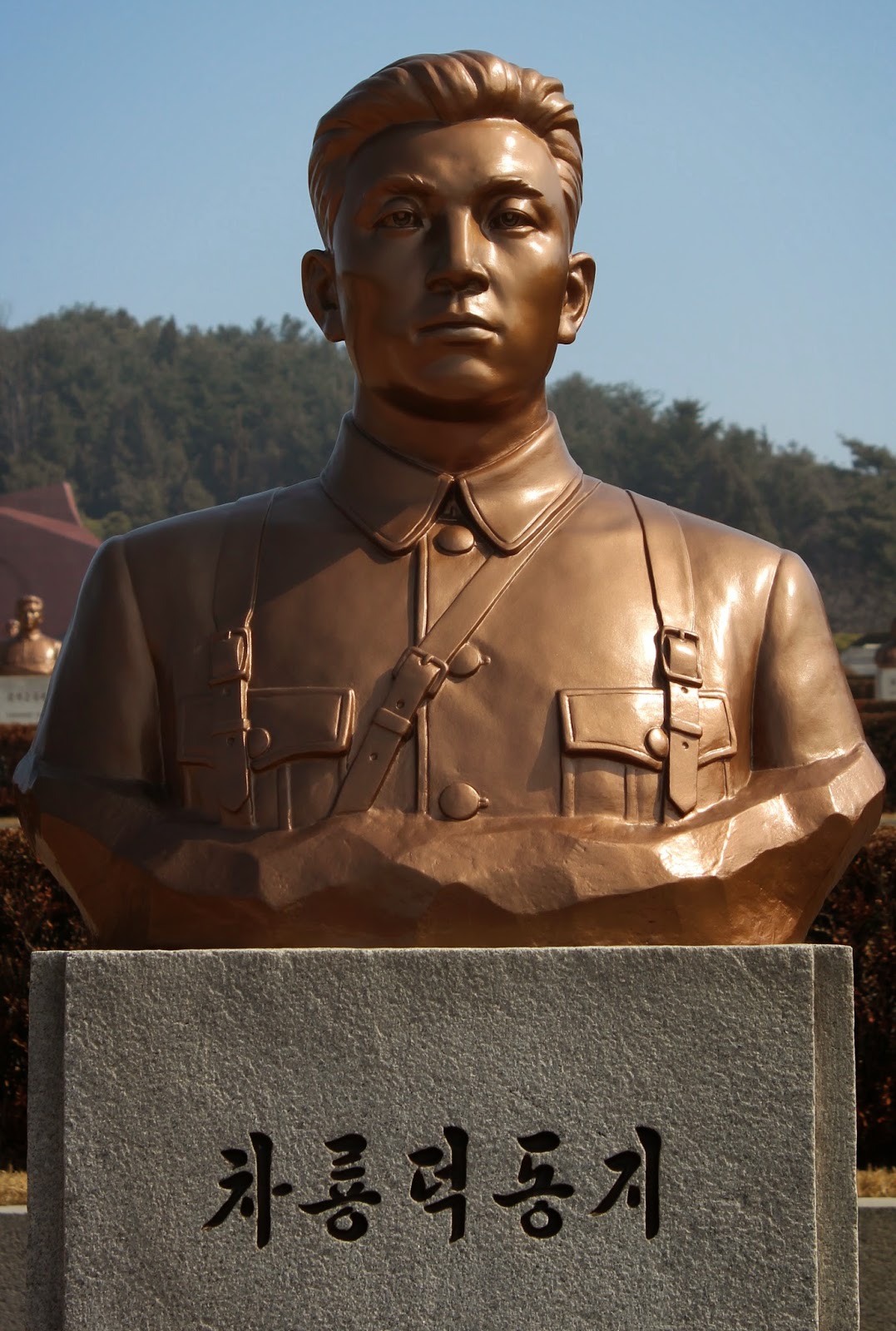
At the Martyrs' Cemetery, it was obvious that a lot of time and expense had been invested. Each headstone was topped with an actual bronze bust of the deceased. It was quite an impressive sight.

Even after the first day in North Korea, I found myself filtering out the constant references to the fight against the Japanese and the subsequent Korean War. Some of what we were told may very well have been true, but I thought that since 70 years had passed, North Korea would be better served thinking more about the future. Of course, I think the main reason why such focus is placed on events of the past is to control and frighten the North Korean population into obedience. What better way to maintain the loyalty and cooperation of the population then to scare them into thinking annihilation is only a short step away?

Following the cemetery, we headed into central Pyongyang to see more of the sights.
Paying homage
Statues, flags, and patriotic slogans were everywhere.
Pyongyang Main Square
By mid-afternoon, I think most of the tour group were a bit jaded from the busy schedule and from the twisted propaganda being fed to us. Throughout most of the trip, I did my best to politely listen and nod in acknowledgement, but on occasions it irritated me slightly. Our trip to the Golden Lane bowling alley was the perfect antidote and allowed me to drink a few (very nice) cold beers and also the opportunity for a Scotland v North Korea game of pool.
On the attack

After some slight trepidation, I found the courage to ask whether or not I could challenge one of the locals to a game. He and his friend were apparently on a date with two of the girls who were watching the game. There did not seem to be too much of a reaction to my request, and they were happy to allow me to play. The local rules were unusual to say the least, but it did not stop me from claiming victory in perhaps the first Scotland v North Korea game of pool. If only international relations were so simple.

The Koreans in the bowling alley were most probably the affluent sector of Pyongyang society. Everything (and everyone) we saw was the best the country could offer - I and my fellow travellers were under no illusions that in the North Korean countryside, the situation is probably very different.
Rush hour - Pyongyang style
After the bowling, we boarded the bus for our journey south towards the DMZ and our overnight stay at the Kaesong Folk Hotel. More to come soon.
The Ryanggang Hotel, Pyongyang

Ryanggang Hotel
For approximately half of our stay in North Korea, we would be staying in Pyongyang, at the Ryanggang Hotel. I wasn't expecting a luxurious experience during my visit to North Korea, although I was hoping to be able to shower each day with warm water. Fortunately, although it took some time for hot water to appear, I managed to have a good shower each morning and night.

Checking in
The hotel was clean, but very basic and very dated. However, it was good enough, the breakfasts and dinners were acceptable, if a little on the cold and bland side. I took some Kikkoman soy sauce with me from Japan which really helped add a bit of taste to the endless supply of omelettes during breakfasts. A couple from the United States passed around their well travelled Tabasco sauce which has apparently accompanied them to all four corners of the world.

As was the case for the whole of our stay in the country, we were not allowed to venture away from the hotel, perhaps not to hide any state secrets, but to protect the North Koreans from any potential embarrassment. There was certainly a very makeshift army camp a couple of minutes from the hotel with very scruffy soldiers pottering about - the guides used very subtle tactics in order to try and divert our gaze during the duration of our stay. On the final night, subtlety was dispensed with and our bus driver turned off all the lights to prevent us getting a further glimpse of the squalor the soldiers were living in.
My room - basic

As is apparent from the photo, the room was very basic. Essentially just a couple of very hard beds (which suited me perfectly) and some space to hang your clothes. The bathroom was actually quite modern and seemed to have been recently redecorated. I was quite happy staying here for 3 nights and I can say that I never had any terrible experiences. I think a good way to describe staying in a North Korean hotel is to say it is a bit like indoor camping. You will come across things which are not perfect, but all the important things like washing, eating, and sleeping will be done to the minimum acceptable standards.
First North Korean dinner
During our evenings in the hotel, there was very little to do but have an early night, or drink beer in the hotel lobby or the rooftop revolving (!) restaurant. Everyone opted to drink beer each night into the small hours. There was a great mix of people on the tour from a number of different countries (France, UK, Ireland, Germany, Poland, USA, Netherlands, Australia, Norway) and the cameraderie was very good indeed - lots of chatting and story telling.
Power cut

One aspect of life in North Korea which we soon all became accustomed to were the power cuts. Throughout our first night in the hotel revolving bar (which did not so much revolve, rather wobble when the motors were on), we had to deal with complete darkness every 30 minutes or so. Each power cut would last 1 or 2 minutes before we could turn off our handheld or iPhone torches. By the second night, we were all fully prepared with torches and the conversations would not even pause as we grew accustomed to the inconvenience.

The Ryanggang Hotel is in a slightly lofty position above Pyongyang. In most cities around the world, you would expect to have some sort of night  view of the city and of the inhabitants going about their business - not in Pyongyang. Complete darkness!

Apologies for my rather lethargic updates regarding my trip to North Korea. I will do my very best over the next few days to give you another insight into my holiday to this rather hermitic country. More soon, I promise....